R-Strategies
The R-Strategies were developed to structure the measures required to shape a Circular Economy (CE). The R-Strategies are used to classify various utilisation and recovery measures hierarchically according to their degree of circularity. The aim of CE measures is to reduce resource consumption and waste and to promote the circular use of materials. Companies’ business models are therefore to be adapted in such a way that current economic systems are transformed into a circular economy.[1] In academic discourse, a distinction is made between various concepts of R-strategies, which also differ in the number of strategies they comprise[2]. For example, Reike et al. (2018)[3] identified 38 distinct R-terms in the literature and synthesised them into ten resource value retention options. Potting et al. (2017)[1] proposed the 9R framework, which comprises ten strategies numbered R0 to R9. This framework is also discussed by Kirchherr et al. (2017)[2]. The different concepts of R-strategies are defined within so-called frameworks. A framework is a system of rules, ideas or beliefs used to plan, classify or make decisions[4]. At ANTS, we refer in our teaching to the 9-R framework proposed by Potting et al. (2017)[1] and discussed by Kirchherr et al. (2017) [2]. In the 9-R framework, the ten R- strategies, R0 to R9, are arranged in descending order according to their degree of circularity[1][2]. This is discussed in more detail below. Depending on their degree of circularity, the R-strategies can be categorised according to three overarching guiding principles: Narrowing, slowing and closing cycles. A high degree of circularity means that materials are kept in the cycle for a long time and, after disposal by the end user, are potentially processed and reused at their original quality. This reduces the demand for primary materials in production, as fewer natural resources are required[5]. The first guiding principle, ‘Narrowing’, aims to increase production efficiency and the intensity of product use, thereby reducing raw material consumption right from the (initial) production of a product. The aim is to use fewer raw materials during manufacturing whilst ensuring the same overall use benefit from the products. The R-strategies R0 to R2 are assigned to this guiding principle according to Kirchherr et al. (2017)[2] (see Figure 1). The second guiding principle, ‘Slowing’, aims to ensure that products or product components remain in the usage stage for longer, thereby extending their service life. The longer service life means that raw materials are retained within the economic system for longer. The R-strategies R3 to R7 are assigned to this guiding principle (see Fig. 1). The third guiding principle, ‘Closing’, aims to ensure that raw materials from discarded products remain within the cycle. The recovery of secondary raw materials reduces the use of primary raw materials, meaning that fewer raw materials are extracted from the environment.[1] To facilitate understanding of the abstract R-strategies, Figure 2 illustrates the nine strategies of the 9R framework using a bicycle as an example.
-
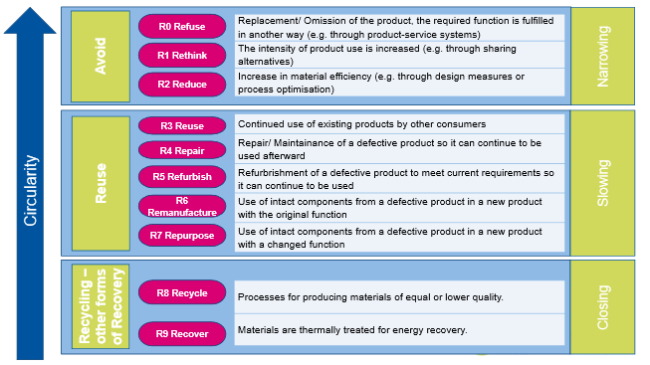
Figure 1: The 9-R framework (own figure based on Potting et al. 2017[1])
-

Figure 2: Examples of R-strategies (own figure based on Mast et al. 2022[5])


The R-strategies serve as recommendations for action for companies to develop circular products, processes and business models. However, the strategies cannot simply be incorporated into the business model; rather, they must be implemented through individual, innovative business ideas that are guided by the R-strategies. It is therefore both possible and desirable for several R-strategies to be implemented within a single company or business model.[5]
References
- ↑ 1,0 1,1 1,2 1,3 1,4 1,5 Potting, J., Worrell, E. & Hekkert, M. (2017): Circular Economy: Measuring innovation in the product chain. PBL Netherlands Environmental Assessment Agency.
- ↑ 2,0 2,1 2,2 2,3 2,4 Kirchherr, J., Reike, D. & Hekkert, M. (2017): Conceptualizing the circular economy: An analysis of 114 definitions. In: Resources, Conservation and Recycling, 127, 221–232. http://dx.doi.org/10.1016/j.resconrec.2017.09.005.
- ↑ Reike, D., Vermeulen, W. J.V. & Witjes, S. (2018): The circular economy: New or Refurbished as CE 3.0?: Exploring Controversies in the Conceptualization of the Circular Economy through a Focus on History and Resource Value Retention Options. In: Resources, Conservation and Recycling 135, 246–264. DOI: 10.1016/j.resconrec.2017.08.027.
- ↑ Cambridge Dictionary: Framework. Available online at: <https://dictionary.cambridge.org/de/worterbuch/englisch/framework/>, last checked on 16 November 2023.
- ↑ 5,0 5,1 5,2 Mast, J., von Unruh, F. & Irrek, W. (2022): R-strategies and innovation in circular economy management: Entrepreneurial strategies for circular value creation. Prospektiven – News on circular value creation, 2022/04. Prosperkolleg e. V.